
High-Gloss Dutch Door
Madison Park, Seattle
This Dutch Door boasts a rich history that traces back to the early 1900s. Cherished by our client, the door, unfortunately, had lost its functionality due to layers of build-up over time. Our team embarked on this project with a commitment to not only restore the door to its pristine original state but also to enhance its allure. Utilizing Fine Paints of Europe’s Hollandlac Brilliant, known for its unparalleled luster and durability, we were able to add a luxurious, inviting appeal to this magnificent entrance. The result is a seamless blend of tradition and luxury, reviving the door’s historical elegance while introducing a modern touch of sophistication.
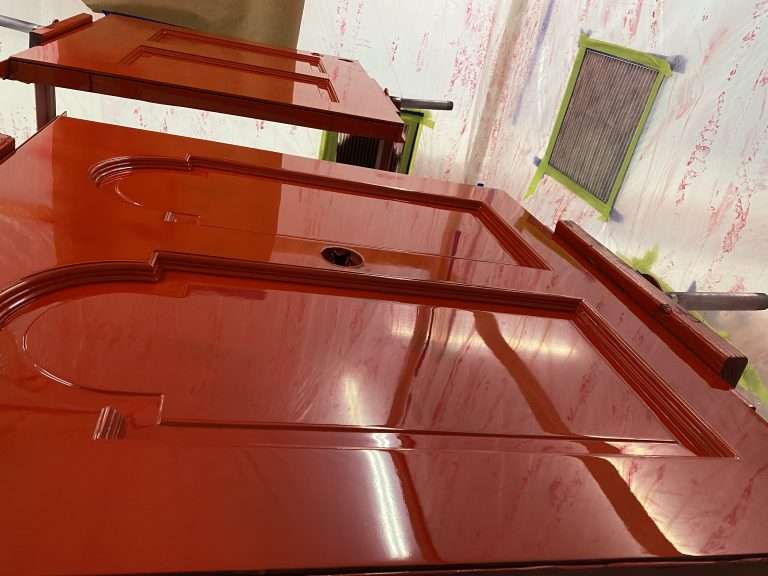

High reflection is synonymous with meticulous preparation.
The journey to attaining a high-gloss finish extends far beyond the mere application of paint; it necessitates an impeccable preparation of the surface. Fine Paints of Europe Hollandlac Brilliant stands out for its unforgiving nature towards any flaws in preparation, where even a minuscule speck of dust can undermine hours of dedicated labor.
For this particular endeavor, we took the crucial step of removing the door and transporting it to our specialized shop. The application of a brilliant finish demands a controlled environment, a prerequisite we rigorously adhere to, ensuring that every brushstroke contributes to an outcome that is as flawless in execution as it is in appearance.

Our Process
STRIPPING THE PAINT OFF:
To initiate the restoration, chemical stripping techniques were employed to meticulously remove over eight layers of paint, revealing the underlying wood. Prior to proceeding with primer application, the exposed wood underwent moisture level testing to ensure optimal conditions for adhesion.
PREPARATION PROCESS:
- Initial Sanding: The first round of sanding utilized a 100-grit sandpaper, aimed at eliminating any residual stripper substance and smoothing out uneven areas.
- First Primer Application: A foundational coat of primer was applied to prepare the surface for subsequent layers.
- Secondary Sanding: The second sanding phase involved a gradual increase in the grit of the sandpaper to refine the surface further.
- Surface Cleaning: Before the application of each coat, the door was thoroughly cleaned to remove any dust or debris that could compromise the finish.
- Layering for Perfection: A total of six coats of Fine Paints of Europe Oil primer were meticulously applied to the door, ensuring an even and flawless finish. Each layer was approached with the precision and care deserving of a final finish coat, including vacuuming the surface, wiping with mineral spirits, and using a tack cloth for ultimate cleanliness and smoothness.

PAINTING PROCESS:
- Initial Sanding: The preparation for painting began with an initial sanding using 220-grit sandpaper, creating a smooth surface that enhances paint adherence.
- First Coat of Paint: Utilizing automotive spray guns for their precision and uniform coverage, the first layer of paint was applied. This foundational coat was left to dry for 24 hours, setting the stage for additional layers.
- Second Sanding: To ensure a flawless base for the subsequent coat, the door was sanded again, this time with 320-grit paper. This step is crucial for removing any imperfections and achieving a perfectly smooth surface.
- Layering for a Mirror-Like Finish: A meticulous application of four thin coats followed, each contributing to the depth and reflective quality of the finish. This technique is essential for achieving a mirror-like appearance, with each coat applied only after the previous one had sufficiently dried.
